 The Mencho Inheritance
ESPEN
The Mencho Inheritance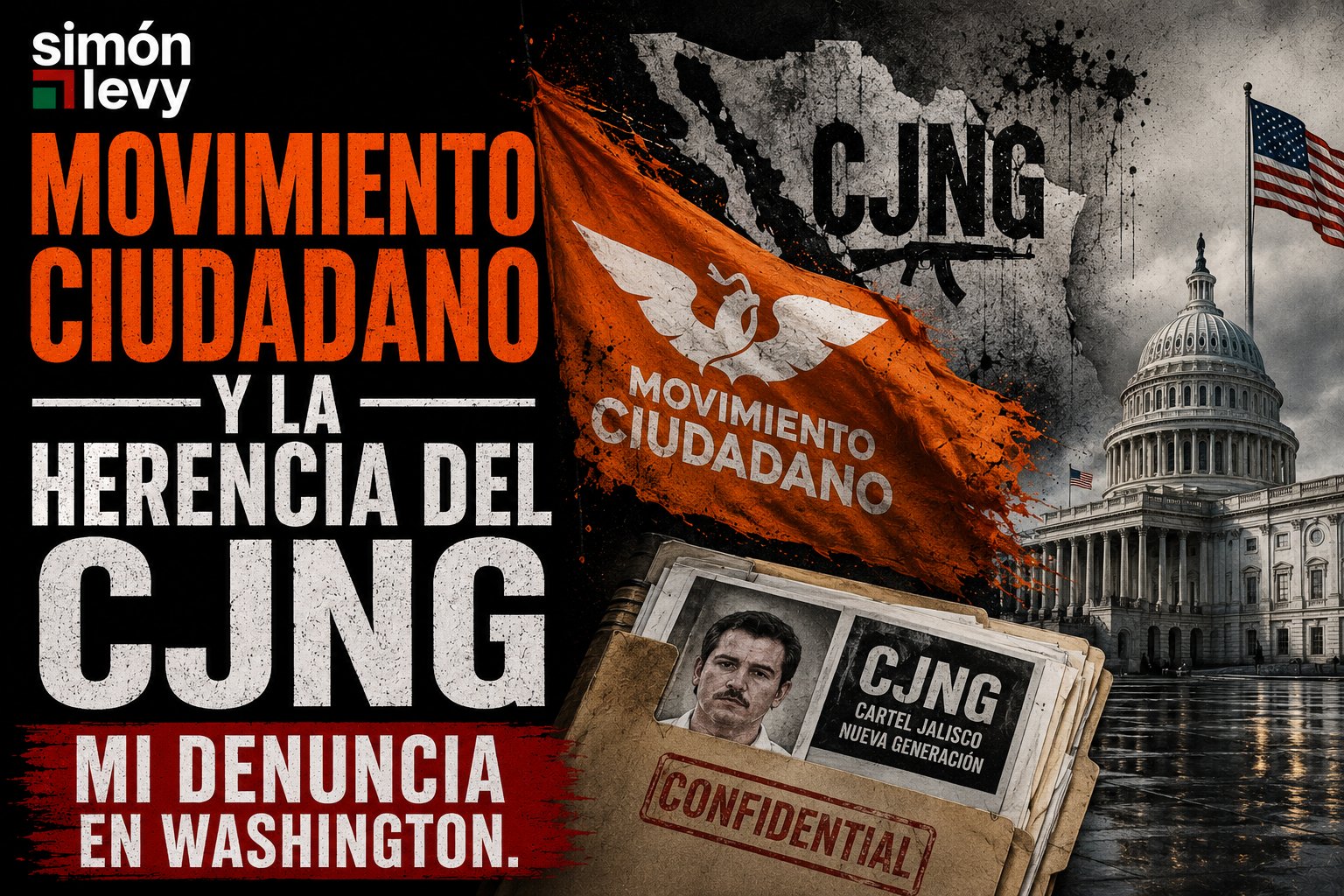
My accusation in Washington.
The boss fell. The financial structure still stands. El Mencho died on February 22 and, three days earlier, the U.S. Treasury had already hit the other CJNG: the one built on resorts, timeshares and luxury hospitality. What decides who inherits the empire is not the bullet, it is the web of companies. And Washington has already changed its target: from the kingpin to the layer that protects him.

This is not a column. It is a formal accusation, and I sign it: Simon Levy, before the authorities of the United States.
I accuse Movimiento Ciudadano as the central political umbrella of the financial inheritance of the Jalisco New Generation Cartel. Not the gunman. The institutional roof that administers the territory where that cartel was born, grew and launders its money.
The fact is hard and verifiable. Jalisco, the home of the CJNG, is governed by Movimiento Ciudadano. There sit the resorts, the timeshares and the web of companies the U.S. Treasury has already sanctioned six times. When the kingpin falls, the flow does not switch off: it changes operator and still needs the same thing, a permit, a front desk, an authority that looks away. That authority has a party. And that party governs the cartel home state.
The file begins where the money begins. And the money begins in Jalisco.
I take this accusation to Washington on the statutes already open: the Kingpin Act, material support to a foreign terrorist organization under 18 U.S.C. 2339B, money laundering under 18 U.S.C. 1956, and in the political layer foreign official extortion. I do not ask for a conviction. I ask for an investigation.
And I do not hide the second layer: Morena governs most of the country, including the states where authorities have already documented infiltration, and in 2027 it pays the price at the ballot box. But the center of this accusation is the umbrella. And the umbrella is in Jalisco.
To understand this accusation you have to understand one thing: Movimiento Ciudadano and Morena are not two projects. They are two brands of the same apparatus.
Movimiento Ciudadano operates as Morena's proxy. It inherits its cadres, its territorial operation and its logic of power, and recycles them under a different name. Where it does not suit Morena to appear, Movimiento Ciudadano appears. The label changes. The function is the same: control of the territory and of the front desk.
The pattern is national, but in Jalisco it is sharp. Jalisco is the home of the CJNG and it is governed by Movimiento Ciudadano. The brand changes, the machinery does not. The structure that administers permits, public works, local security and the rolls is the same that operates in the Morena states. A different color on the ballot, the same apparatus in power.
The cartel does not vote by party. It votes for whoever controls the territory.
And here is the point that matters for this complaint. Organized crime does not distinguish party labels. It uses Morena and Movimiento Ciudadano interchangeably, as the territory dictates. The CJNG, and now El Mencho's financial successor, does not need a party. It needs a local authority that looks away. That authority can wear one color or another. The function is identical.
That is why the accusation does not stop at a label. I accuse the apparatus. And that apparatus governs the cartel's home state under the Movimiento Ciudadano brand.
On February 22, 2026, Mexican federal forces killed Nemesio Oseguera Cervantes, El Mencho, in Tapalpa, Jalisco. The operation had U.S. intelligence support. Twenty-five National Guard members and eight cartel members died.
What almost no one connected: three days earlier, on February 19, the U.S. Treasury had already struck the other CJNG. Not the one with rifles. The one built on resorts, timeshares and luxury hospitality near Puerto Vallarta.
That is the key to this whole investigation. A modern cartel is not an armed gang. It is a financial structure with an armed arm. Take away the arm and the money keeps moving. The question is not who picks up the rifle. It is who inherits the companies.
And here Washington steps in with a new playbook. For decades it chased kingpins. Today it chases the clean money and, above all, the officials who protect it. That shift is what puts Morena in front of the mirror heading into 2027.
The February 19 strike was not improvised. It was the sixth time OFAC sanctioned the CJNG timeshare fraud network. The cumulative total by the end of February passed 90 people and entities.
The target this time: Kovay Gardens, a 22 room beachfront resort in Nayarit, 45 minutes from Puerto Vallarta. Behind it, according to the Treasury, a fraud machine running call centers to drain the savings of U.S. tourists, many of them older adults.
The sectors touched by the designation draw the laundering map: timeshare, real estate, tourism, travel, automotive services, accounting and financial services. This is not a business. It is an economic operating system embedded in the formal economy of Jalisco and Nayarit.
The bullet kills a person. The web of companies outlives any funeral.
Tap each step. The fraud money does not die with the kingpin: it changes hands, not its channel.
Mexican federal authorities reported that four CJNG successor figures are under investigation after El Mencho's death. The structure operated through regional cells with tactical autonomy. Security analysts had already warned that the fall of the supreme command could trigger a dispute among higher ranking regional operators.
On the financial front, the visible piece is Audias Flores Silva, El Jardinero, named as an operator of the timeshare fraud. He was arrested on April 27, 2026 and faces a U.S. extradition request. The resort websites went dark. The command layer that collected from the call centers was struck.
Here is the point that matters for the money. Criminal succession is not settled with a new boss. It is settled by who controls the accounts, the permits and the local political protection. Whoever inherits the companies needs local authorities to keep looking away.
The CJNG throne is not inherited with a rifle. It is inherited with a notary signature and a municipal permit.
Tap each button. Washington did not change its enemy. It changed its target inside the enemy.
The CJNG was designated a Foreign Terrorist Organization and Specially Designated Global Terrorist in February 2025. That is not rhetoric. It turns any material support to the cartel into a federal crime under 18 U.S.C. 2339B, and opens the full catalog: money laundering, the Kingpin Act, the executive orders and, in the political layer, the statutes against the official who demands or who protects.
If you want to understand where the pressure on the political layer is heading, look at Sinaloa. In April 2026, the U.S. Attorney for the Southern District of New York indicted the then governor of Sinaloa, Ruben Rocha Moya, a Morena member, together with nine other people in his circle, for allegedly collaborating with the Sinaloa Cartel.
Rocha Moya requested a leave of absence in early May 2026. He has publicly denied the accusations. He is presumed innocent. What matters for this investigation is not the case itself, but the model it opens: a sitting governor, from the ruling party, inside a U.S. federal criminal file.
For the first time, the risk is not for the kingpin. It is for whoever signs from power.
Weeks later, the Treasury sanctioned more than a dozen Sinaloa Cartel kingpins and laundering companies. The sequence is the same as in the CJNG case: first the financial map, then the layer that covers it.
A cartel's financial flow needs territory. And territory is administered from the municipality: permits, public works, local security, the rolls, the front desk. That is where criminal money and politics touch every day.
This is not theory. In May 2026, federal authorities documented the Sinaloa Cartel infiltration of eight municipalities in Morelos, a state governed by Morena. The Financial Intelligence Unit announced the blocking of 32 subjects, 22 individuals and 10 companies, among them alleged municipal presidents and officials of the Cuautla city government.
Within Operation Enjambre, the municipal president of Atlatlahucan and the former municipal president of Yecapixtla were arrested, among other officials, for their alleged link to a criminal network. All are presumed innocent.
| Documented case | Level | Authority | Status |
|---|---|---|---|
| Infiltration in 8 Morelos municipalities | Municipal | Federal security / UIF | 32 subjects blocked |
| Municipal president of Atlatlahucan | Municipal | Operation Enjambre | Arrested, alleged |
| Former municipal president of Yecapixtla | Municipal | Operation Enjambre | Arrested, alleged |
| Governor of Sinaloa (Rocha Moya) | State | DOJ, SDNY | Indicted, denies it |
The Presidency itself acknowledged it. President Claudia Sheinbaum admitted, in public remarks, that there have been some cases of links between certain municipal governments and organized crime, and for that reason she pushed to empower the INE to vet candidate profiles heading into 2027.
When the government proposes to filter its own candidates, it is admitting the size of the problem.
No shortcuts here. The CJNG financial heartland, Jalisco, is not governed by Morena: it is governed by Movimiento Ciudadano. Saying otherwise would be false, and a false data point destroys an entire investigation.
Morena's exposure is not in painting Jalisco its color. It is in something more serious and more verifiable: Morena governs most of the country, including the states where authorities have already documented criminal infiltration in government. Sinaloa, Morena. Morelos, Morena. Nayarit, neighbor to the CJNG heartland, Morena.
The argument stands on its own: when a party controls the territory where the State itself acknowledges infiltration, the political cost of every foreign designation falls on that party. Not by ideology. By the arithmetic of government.
In 2027 Mexico holds the midterm elections of Morena's second administration. The party will seek to preserve and expand its territorial power. And it will do so under a double pressure no Mexican party had faced before.
Long campaigns, clientelism and territorial operation cost money. Where legal financing falls short, the temptation of criminal money appears. It is the same mechanism authorities documented in Morelos and Sinaloa.
Every OFAC designation and every DOJ indictment against a profile tied to the ruling party becomes electoral ammunition. The Rocha Moya case showed that a sitting governor can end up inside a U.S. federal file.
The consequence is measurable. Every foreign action against an official will validate the opposition narrative and erode the ruling party brand. Washington's clock and the Mexican electoral calendar cross in 2027. That is why the government itself is pushing a reform so the INE can filter candidacies. It knows what is coming.
It is not a security risk. It is a ballot box risk.
The regional operator who controls the accounts, the permits and the municipal stamp. The corporate structure that changes its name and reopens. The local protection that keeps charging for the appointment.
The older adult who lost their savings in a phantom timeshare. The citizen of Morelos or Sinaloa living with the infiltration. And the ruling party, which carries the electoral cost of every foreign file.
Guadalajara, capital of Jalisco and CJNG heartland, hosts four 2026 World Cup matches at Estadio Akron, between June 11 and 26. Jalisco expects around three million visitors. The FIFA Fan Festival projects up to 65,000 people per day.
That means guaranteed global attention on the territory where the cartel financial succession is open, right when the Treasury and the DOJ have the file hot. The window of relevance is not months. It is days. The last match in Guadalajara is June 26.
The world is going to watch Jalisco. The question is what it will see.
Tap each statute. Legal framework and educational tool. It is not an indictment of any person.
This investigation does not accuse a party of being a cartel. It holds three verifiable things documented by authority.
One. El Mencho's death does not switch off the CJNG financial structure. OFAC has been mapping it for six rounds, and the succession of the flow, not the rifle, is what defines control.
Two. The U.S. model shifted from the kingpin to the political layer. The case of the Sinaloa governor, a Morena member indicted by the DOJ, is the living precedent.
Three. The hinge is the municipality. Mexican authorities themselves documented infiltration in municipal governments of Morena governed states, and the Presidency acknowledged it by proposing to filter candidacies heading into 2027.
The conclusion is analysis, not a verdict: in 2027, every financial action by Washington against an official becomes a Mexican electoral fact. That is El Mencho's real inheritance.
The applicable framework includes the Kingpin Act, Executive Orders 13224 and 14059, material support to an FTO under 18 U.S.C. 2339B, money laundering under 18 U.S.C. 1956, and in the political layer the statutes on foreign official extortion and bribery. Every allegation is subject to the presumption of innocence and to the determination of the competent authority.
| Fact | Primary source | Date |
|---|---|---|
| Kovay Gardens sanction, 6th CJNG timeshare round | U.S. Treasury, OFAC | Feb 19, 2026 |
| Death of El Mencho in Tapalpa | FGR, death certificate 3830 | Feb 22, 2026 |
| Indictment of Rocha Moya | DOJ, SDNY . S9 23 Cr. 180 | Apr 2026 |
| Arrest of El Jardinero, extradition | Federal authority / OFAC | Apr 27, 2026 |
| UIF blocking, 32 subjects, Morelos | UIF SHCP / federal security | May 2026 |
| 4 successor figures under investigation | Federal security | 2026 |